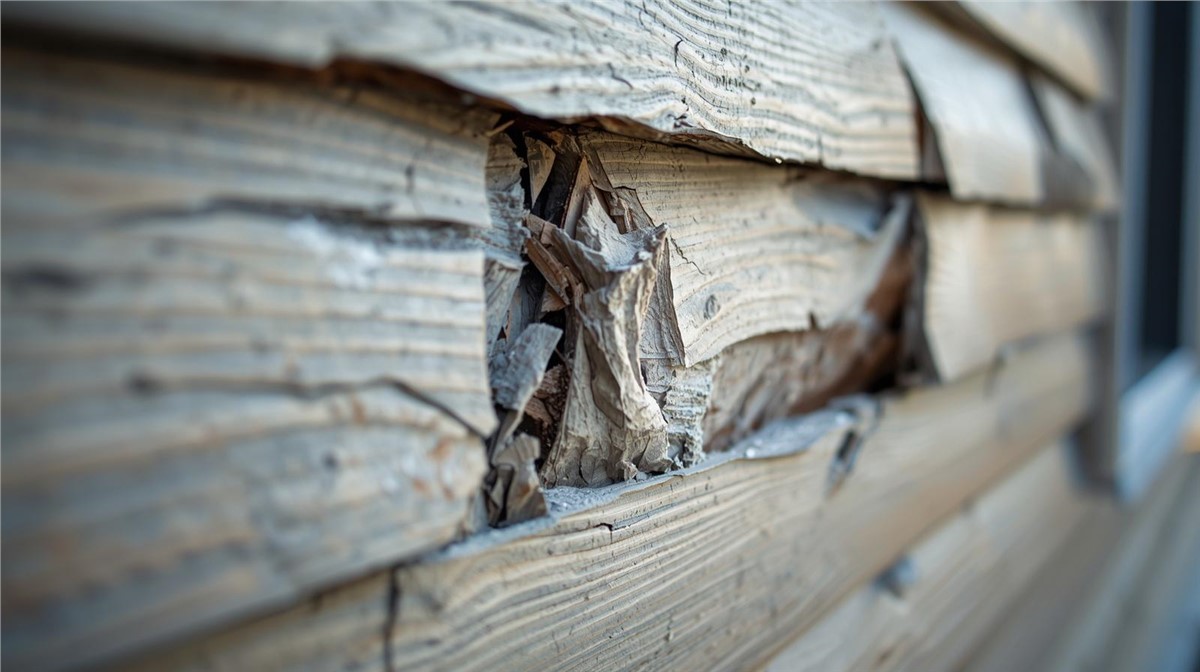
Cracked, warped, and loose siding panels are not cosmetic problems — in Genoa, IL, where northern Illinois weather puts sustained stress on every exterior surface, each one is an entry point for moisture, cold air, and the kind of slow structural damage that compounds quietly across seasons. This guide covers what causes each type of siding damage, what it is doing to the wall system behind it, and how to evaluate the right response before small problems become expensive ones.
Why Damaged Siding Deserves More Attention Than It Usually Gets
Siding damage has a way of sitting on the low end of a homeowner's priority list. A cracked panel does not drip. A warped section does not produce an obvious interior symptom. A loose panel looks like a minor imperfection from the street. The house feels fine. The problem gets noted, mentally filed, and deferred until the next round of exterior projects.
That deferral has a cost. In a climate like DeKalb County's — where freeze-thaw cycling works at every gap and seam through a northern Illinois winter, where wind-driven rain exploits every vulnerability in the wall system, and where a single season of neglect can move a surface problem into the sheathing behind it — the timeline between "I should get to that" and "this is now a much bigger project" is shorter than most homeowners expect.
Genoa is a community in DeKalb County where that weather pattern is a consistent reality. Understanding what each type of siding damage is actually doing to the building — not just what it looks like from the driveway — changes the calculus on how quickly it deserves attention.
Cracks: What Causes Them and What They Allow In
Cracked siding is the most straightforward damage type to identify and the one whose consequences are most directly traceable. A crack is an open point in the weather barrier. What gets through it depends on the size of the crack, the direction of the prevailing weather, and how long the crack has been there.
What Causes Siding to Crack
Impact damage. Hail is the primary impact source in northern Illinois — in DeKalb County, meaningful hail events occur across spring and summer storm seasons. Hailstone impact on vinyl siding produces cracks that range from hairline fractures to full panel splits, depending on the hailstone size, impact angle, and the temperature and age of the material at the time of impact. Cold-weather impact events produce more cracking than warm-weather ones because vinyl becomes increasingly brittle as temperatures drop.
Debris impact — branches, wind-carried objects, or material from adjacent properties during high-wind events — produces localized cracking that is typically more concentrated than hail damage and easier to attribute to a specific event.
Thermal stress. Vinyl siding expands in heat and contracts in cold. Over the full temperature range experienced in DeKalb County — which spans well over 100 degrees Fahrenheit between extreme winter and summer conditions — a single panel of vinyl siding moves significantly across the seasons. When panels are installed too tightly — nailed too firmly through the nail slot rather than allowed to slide freely — that movement has nowhere to go. The panel buckles, stresses at its weakest points, and eventually cracks.
This type of crack typically appears at panel ends, at corners, and near fastener points — locations where thermal movement is most restricted. It is an installation error whose consequences appear years after the job was done, not immediately.
Age-related brittleness. Vinyl siding that has been in place for 20 or more years becomes progressively more brittle as UV exposure degrades the polymer compound and the UV stabilizers in the material are depleted. Older brittle vinyl cracks from impacts and thermal stress that newer material would handle without damage — and it cracks during cold weather from minor impacts that would not crack a new panel under the same conditions.
Fiber cement and wood cracking. On homes with fiber cement or wood siding, cracking has different mechanisms. Fiber cement fractures at impact points and can develop edge delamination when moisture infiltrates cut surfaces that were not properly back-primed at installation. Wood siding cracks when paint or stain is allowed to fail — the exposed wood absorbs and releases moisture repeatedly, and the swelling and shrinking cycle eventually splits the wood fibers.
What a Crack Is Doing to Your Wall System
A cracked siding panel is an open gap in the primary weather barrier. The consequences depend on severity and duration.
At the housewrap surface, water that infiltrates through the crack encounters the secondary moisture barrier. If the housewrap is intact and properly installed, it sheds most of that water. If the housewrap has been compromised — by prior water exposure, by improper installation, or simply by age — water reaches the sheathing.
Sheathing that absorbs moisture repeatedly softens and delaminate — OSB panels in particular lose structural integrity when they have been wet and dried through multiple cycles. Wet sheathing also supports mold growth on its interior surface — not visible from outside, not detectable without removing panels, and capable of spreading to adjacent framing members before it announces itself through any interior symptom.
In winter, water in a crack freezes. The expansion of freezing water — approximately nine percent — widens the crack with every freeze cycle. A hairline crack in October can be a visible gap by March without any additional impact or weather event having occurred.
Warping: What It Means and Why It Matters
Warped siding is more consequential than it looks. A panel that bows outward, buckles along its length, or has pulled away from the wall surface at an edge is not just a cosmetic problem — it is a panel that has lost contact with the locking channel of the course below it, is no longer shedding water correctly, and is allowing air and moisture infiltration behind the cladding continuously.
What Causes Siding to Warp
Installation with insufficient nailing clearance. This is the most common cause of vinyl siding warping. Vinyl must be nailed through the center of the nail slot — not tight against the slot edge — and nails must be driven to leave the panel able to slide laterally as it expands and contracts with temperature. Nails driven too tight lock the panel against movement. When heat causes the panel to expand in summer, the locked panel has nowhere to go and bows outward. This is the buckling pattern that appears on the sunny elevations of homes in warm weather and is the signature of an installation error made when the siding was installed.
Heat from reflected surfaces. A known but underappreciated cause of vinyl siding warping is concentrated radiant heat from nearby reflective surfaces — most commonly from low-e glass windows on adjacent structures that focus reflected sunlight onto a siding surface. The concentrated heat can exceed what the vinyl compound is rated to handle, causing permanent deformation. This is a situation-specific cause that requires investigation of the reflective source rather than just the damaged panels.
Moisture behind panels. Panels that bow outward from the wall — particularly at lower courses and near grade — may be responding to moisture pressure from behind. Wet sheathing swells. Wet framing moves. Either can push siding panels outward from behind. This type of warping is a symptom of a moisture problem behind the wall rather than a material or installation problem with the panel itself — and replacing the warped panel without addressing the moisture source behind it produces the same failure in the replacement panel.
Age and UV degradation. Vinyl that has been in place for 25 or more years loses the flexibility that allows it to manage thermal movement without deforming. Older panels warp at lower temperature differentials than newer material — what the original installation handled through seasonal cycles becomes more than the aged material can accommodate.
What Warping Is Doing to Your Wall System
A warped panel that has bowed away from the wall has lost contact with the locking channel of the course below it at one or more points. That lost contact is a gap — continuous air and moisture infiltration whenever pressure conditions favor it. Wind-driven rain does not need a large gap to find its way behind siding. The gap created by a bowed panel during a windstorm is sufficient.
More concerning is what warping often indicates about the conditions behind the panel. Warping caused by moisture pressure behind the wall means the sheathing or framing has already absorbed enough moisture to physically move the cladding. By the time a panel bows from behind, the moisture source has typically been present for a significant period.
Loose Panels: The Failure Most Homeowners Underestimate
A loose siding panel — one that has disengaged from the locking channel of the panel below it, that rattles in the wind, or that can be pushed in and out by hand — is the failure mode that most consistently gets dismissed as minor. It looks like the panel just needs to be snapped back into place.
Sometimes it does. Often it indicates something more consequential.
What Causes Panels to Come Loose
Wind events. High wind gets under panel edges — particularly at laps, at corners, and at any point where the panel has not fully engaged its locking channel — and lifts the panel free. A single high-wind event can disengage multiple panels on a windward elevation. Panels that disengage in wind events but are otherwise sound can typically be re-engaged if the locking channel and the panel edge are undamaged.
Failed hanger or fastener. Panels that are held in place partly by their locking channel engagement and partly by their fasteners through the nail strip. If the nails or screws at the nail strip have backed out — from thermal cycling, from vibration, or from fastening into sheathing that has softened from moisture exposure — the panel loses its upper attachment and relies entirely on the locking channel, which is not designed to be the sole retention mechanism.
Substrate movement. Sheathing that has been compromised by moisture may shift or compress at fastener points, allowing nails to back out and panels to loosen. This cause of loose panels is associated with a more significant underlying problem than the loose panel itself.
Improper installation overlap. Panels that were not fully engaged in their locking channels at installation may stay in place for years and then disengage under wind or thermal stress. The engagement was marginal from day one — the weather eventually found it.
What a Loose Panel Is Doing to Your Wall System
A loose panel that has disengaged from its locking channel is no longer managing water correctly. Water that runs down the face of the wall above the loose panel does not make the transition onto the surface of the lower course — it runs behind the panel and contacts the housewrap directly. In a sustained rain event, or in wind-driven rain, this is a significant infiltration volume at a point that the wall system was not designed to manage.
A loose panel that is rattling in wind is also a panel that is mechanically stressing its locking channel edges with every movement. A panel that has been rattling for a season develops fatigue damage at those edges that makes it more likely to crack and less likely to re-engage securely even if snapped back into place.
The Hidden Damage Behind the Visible Problem
Each of the three damage types — cracks, warping, and loose panels — is a surface symptom. What it is doing behind the surface is what determines the true scope of the problem.
The progression is consistent across all three:
- The surface failure creates an infiltration pathway
- Water reaches the housewrap — the secondary moisture barrier
- If the housewrap is intact, it sheds most of the water; if it is compromised, water reaches the sheathing
- Sheathing absorbs moisture repeatedly through rain events and freeze-thaw cycling
- Sheathing softens, delaminates, and develops mold on its interior surface
- Moisture reaches wall cavity insulation and framing members
- Interior symptoms appear — wall discoloration, mold smell, soft drywall — by which point the scope of remediation has expanded well beyond the original siding repair
The earlier in this progression the problem is identified and addressed, the less expensive the repair. A cracked panel caught in the same season it was damaged is a panel replacement. The same crack discovered two years later after multiple wet seasons have worked through it may be a panel replacement plus sheathing repair plus mold remediation.
Assessing the True Scope: What a Professional Inspection Finds
A homeowner walk-around identifies the visible surface damage. A professional inspection identifies what that damage has done to the wall system behind it — and whether the repair scope is limited to the surface or extends into the substrate.
What a professional siding inspection covers beyond the surface:
Pressure testing of suspect panels. Pressing firmly on panels adjacent to damage points — particularly those showing warping or in areas below cracked panels — identifies soft spots in the sheathing beneath. A healthy wall feels firm and solid. Sheathing that has absorbed moisture feels softer, sometimes with a slight give that indicates compromised structural integrity.
Moisture detection. A contractor with moisture detection equipment can assess moisture levels in the wall assembly behind suspect panels without removing them — identifying whether infiltration has been occurring and to what extent.
Inspection at grade and penetrations. The base of wall sections near grade and the surrounds of every utility penetration are the highest-risk locations for moisture infiltration — the points where water management details are most commonly inadequate and where damage accumulates fastest. Professional inspection gives these areas specific attention.
Trim and flashing condition. Every corner post, J-channel, window surround, and utility cover is examined for condition, engagement, and sealant integrity. Failed trim components at the perimeter of the damage area are often the entry point that allowed the visible damage to develop in the first place.
Documentation for insurance purposes. Where damage is storm-related — hail cracks, wind-loosened panels — a professional inspection report with photographs documents the findings in a form suitable for insurance claim submission. This documentation is most useful when produced promptly after the storm.
Repair or Replace: How to Evaluate the Right Response
The repair-versus-replace decision for damaged siding in Genoa follows the same logic as for other exterior components — scope and system condition determine the right answer.
Repair is the appropriate answer when:
- Damage is limited to a small number of discrete panels with no evidence of moisture infiltration behind them
- The surrounding siding is in sound structural condition — no widespread cracking, brittleness, or warping
- The siding is less than 15 years old
- Matching replacement panels are available in a compatible profile and color
- The cause of the damage — impact, installation error, or specific event — has been identified and does not indicate a systemic problem
Replacement is the stronger answer when:
- Damage is widespread across multiple elevations or involves multiple concurrent failure types
- Moisture infiltration behind panels has affected sheathing or framing in multiple areas
- The siding is 20 or more years old and the material is brittle, faded, and prone to cracking from minor stress
- Matching material is unavailable and the visual result of repairs would be inconsistent
- The cause of warping or loosening is substrate moisture — indicating a systemic problem that a panel-level repair cannot address
The middle answer — the honest assessment of the full system rather than just the visible surface — is what a professional inspection produces. What is damaged now, what is marginal, what is the most cost-effective path over a five to ten year horizon — that conversation produces better decisions than either reflexive repair or automatic replacement.
Acting Before the Next Season Makes It Worse
Genoa's northern Illinois climate does not give damaged siding time to stay stable. A cracked panel in September faces freeze-thaw cycling beginning in November. A loose panel going into winter faces ice loading and wind events that will worsen its disengagement. A warped panel that is allowing infiltration now will allow more of it through a wet spring.
The cost of acting promptly on identified siding damage is the cost of the repair. The cost of deferring it through a northern Illinois winter is the cost of the repair plus whatever the winter added to the scope behind the wall.
Contact Huskie Exteriors for professional roofing, siding, window, gutter, and storm damage services in Illinois and Wisconsin. If your Genoa home has cracked, warped, or loose siding panels — or if a recent storm has raised questions about what your exterior has been through — our team is ready to inspect, document, and give you an honest assessment of what the damage involves and what it needs.
Subscribe to Huskie Exteriors's Blog



Comments