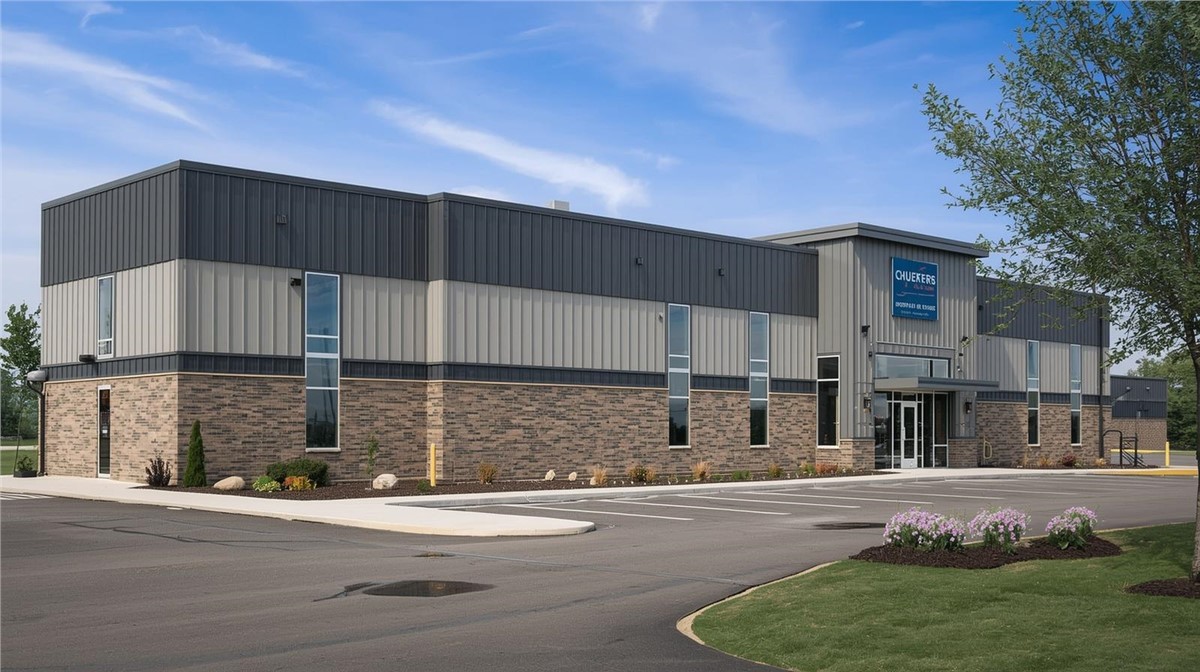
The exterior cladding on a commercial building in South Elgin, IL does more than establish curb appeal — it protects the structure, manages moisture, and represents the business inside it to every customer and tenant who approaches the door. This guide covers the most practical commercial siding options for the northern Illinois climate, what drives material selection for different building types, and what property owners and facility managers should look for when planning a siding project.
Why Commercial Siding Deserves Serious Attention
Commercial exterior cladding takes more punishment than residential siding in almost every respect. The surface areas are larger, the exposure to weather is more sustained, the consequences of failure affect more people, and the decisions about materials and maintenance tend to be made less frequently — which means when they are made, they need to be right.
In South Elgin, IL, a growing community in Kane County along the Fox River, the commercial real estate landscape includes retail storefronts, office buildings, light industrial facilities, mixed-use developments, and medical and professional service properties. Each building type has its own functional requirements, aesthetic expectations, and budget constraints — and each faces the same northern Illinois climate that makes material selection genuinely consequential.
Freeze-thaw cycling, hail exposure, sustained wind from fast-moving weather systems, and summer UV intensity all degrade exterior cladding over time. For a commercial property, that degradation translates directly into maintenance costs, repair bills, tenant complaints, and ultimately into the perception of the business or property from the street. Getting material selection and installation right at the outset is a more cost-effective path than replacing a marginal system prematurely.
How Commercial Siding Differs From Residential
Before reviewing specific material options, it is worth understanding what makes commercial siding a distinct category from residential cladding — because the differences affect material selection, installation requirements, and long-term management.
Scale. Commercial buildings cover larger surface areas with fewer transitions. A single elevation on a commercial building may span hundreds of square feet without a break, which affects how materials perform under thermal movement, how water is managed across large expanses, and how maintenance is accessed and executed.
Building codes and fire ratings. Commercial construction is subject to more stringent building code requirements than residential, including fire resistance ratings for exterior cladding that vary by occupancy type and proximity to adjacent structures. Material selection on a commercial building must account for code compliance, not just performance and aesthetics.
Occupant and operational considerations. A commercial siding project on an occupied building needs to be coordinated around business operations. Noise, access restrictions, dust management, and staging all require more planning than a residential project. A contractor with commercial project management experience handles these logistics differently than one whose primary work is residential.
Longevity expectations. Commercial property owners typically expect exterior cladding to perform for 20 to 30 years or more with minimal maintenance intervention. Material selection on a commercial building needs to be evaluated on a total cost of ownership basis — not just upfront cost, but maintenance requirements, repair costs, and expected service life across the full ownership horizon.
Aesthetic and brand alignment. For retail, restaurant, medical, and professional service properties, exterior appearance directly affects customer perception. Material selection needs to account for the visual identity the business wants to project and the aesthetic context of the surrounding commercial district.
Commercial Siding Material Options for South Elgin Properties
The material landscape for commercial exterior cladding is broader than most property owners initially realize. Here is a practical overview of the options most relevant to commercial properties in the South Elgin market.
Metal Panel Siding
Metal panel systems — available in aluminum, steel, and composite metal — are among the most widely used cladding choices on commercial buildings across northern Illinois, and for good reason. They are durable, low maintenance, fire resistant, and available in a wide range of profiles, colors, and finishes that accommodate everything from industrial to contemporary aesthetic requirements.
Aluminum panel systems are lightweight, corrosion-resistant, and handle thermal movement well. They are appropriate for a wide range of commercial applications from retail to light industrial. Factory-applied paint finishes on quality aluminum panels hold color well under UV exposure and resist the chalking and fading that lower-quality finishes develop over time.
Steel panel systems offer greater rigidity and impact resistance than aluminum — a meaningful advantage in hail-prone areas. Steel panels are heavier, which affects structural loading considerations, and require more attention to corrosion protection at cut edges and fasteners. Galvanized or Galvalume steel with quality paint finishes performs well in the northern Illinois climate when properly detailed.
Standing seam metal panels — where the panel joints are raised above the face of the cladding rather than flush with it — provide a clean, contemporary aesthetic and superior weather resistance at seam joints. They are increasingly common on commercial, institutional, and mixed-use buildings in the Kane County market and hold up well under Midwest weather conditions.
Corrugated and ribbed metal panels are practical for industrial and agricultural applications, less appropriate for retail or professional service properties where aesthetic expectations are higher. Their lower cost makes them a reasonable choice for warehouse, storage, and light industrial buildings where function takes priority over appearance.
Fiber Cement Cladding
Fiber cement is a composite material made from cement, sand, and cellulose fibers that offers the dimensional appearance of wood with the durability and moisture resistance of a cementitious product. It is available in lap siding, panel, and trim configurations, and factory-primed or pre-finished options reduce on-site finishing requirements.
For commercial applications in South Elgin, fiber cement is most appropriate for mixed-use, retail, and professional service buildings where a traditional or residential-adjacent aesthetic is desired. It is not the right material for large industrial applications — its weight and installation requirements make it impractical at that scale — but for smaller commercial buildings, storefronts, and the residential components of mixed-use developments, it performs well and holds paint for significantly longer than wood.
Fiber cement is not maintenance-free. It requires periodic repainting — typically every 10 to 15 years on a commercial building in a northern Illinois climate — and attention to joint sealants and flashing details that, if neglected, allow moisture into the substrate and can cause edge swelling and delamination over time. Properly specified, installed, and maintained, it is a durable and attractive option for the right application.
EIFS (Exterior Insulation and Finish Systems)
EIFS — commonly referred to as synthetic stucco — is a multi-layer cladding system consisting of insulation board attached to the substrate, a reinforced base coat, and a textured finish coat. It is widely used on commercial buildings for its design flexibility, thermal performance, and ability to accommodate complex architectural shapes and profiles.
EIFS delivers genuine energy efficiency benefits by providing continuous insulation across the wall surface, eliminating the thermal bridging through wall framing that reduces the effectiveness of cavity insulation. For commercial buildings in South Elgin where energy costs are a meaningful operating expense, this thermal performance advantage is worth quantifying in a cost-benefit analysis.
The material's primary vulnerability is moisture. EIFS systems that lack proper drainage capability — older "barrier" EIFS systems that relied entirely on perfect sealant performance — have a problematic track record with moisture infiltration when sealants fail at joints, windows, and penetrations. Modern "drainable" EIFS systems with a drainage plane behind the insulation layer address this vulnerability significantly. For any commercial EIFS installation, drainable system specification and meticulous detailing at all terminations and penetrations is non-negotiable.
Post-storm inspection of EIFS cladding is important after hail events. Hail impact creates craters in the finish coat that may not be immediately obvious but breach the weather barrier and require prompt repair to prevent moisture infiltration into the insulation layer.
Brick and Masonry Veneer
Brick veneer and concrete masonry unit (CMU) cladding remain common on commercial buildings in the South Elgin area, particularly on buildings constructed before the widespread adoption of metal panel and EIFS systems. Brick is durable, low-maintenance relative to painted systems, and carries a permanence and quality perception that resonates with certain commercial contexts — professional services, medical, financial, and institutional applications particularly.
For commercial property owners with existing brick veneer, maintenance involves periodic tuckpointing of mortar joints — typically every 25 to 30 years on a well-constructed brick building — and attention to parapet walls, sills, and lintels where water management details are most consequential. Neglected mortar joints allow water infiltration that can damage wall ties, brick faces, and the structure behind the veneer over time.
New brick veneer installation on commercial buildings is not common in the current market relative to metal panel and EIFS alternatives, primarily due to cost and installation time. Where it is specified, it is typically for institutional or high-end commercial applications where the material's permanence and aesthetic justify the premium.
Composite and Engineered Wood Panels
Engineered wood panel systems — including products like LP SmartSide panels — offer a wood-grain aesthetic with meaningfully better moisture resistance and dimensional stability than natural wood. They are available in large panel formats appropriate for commercial application and can be finished in a wide range of paint colors.
For smaller commercial buildings, retail storefronts, and mixed-use applications in South Elgin, engineered wood panels are a practical middle ground between fiber cement and metal — more affordable than fiber cement at scale, more dimensionally stable than natural wood, and aesthetically appropriate for a broader range of commercial contexts than metal panel.
They require periodic repainting and are not appropriate for applications with significant moisture exposure at grade without careful flashing and clearance detailing. For the right application with proper installation and maintenance, they perform well in a northern Illinois climate.
What Drives Material Selection for South Elgin Commercial Properties
With multiple viable options available, the material selection decision for a specific commercial property in South Elgin comes down to five primary factors.
Building type and occupancy. An industrial warehouse and a medical office building have fundamentally different aesthetic requirements, code obligations, and maintenance expectations. Metal panel is appropriate for both but in very different profiles and finishes. EIFS may be appropriate for the medical building but impractical for the warehouse. Starting with building type narrows the field quickly.
Budget — upfront vs. total cost of ownership. Metal panel and EIFS typically have higher upfront costs than vinyl or engineered wood but lower long-term maintenance costs. Fiber cement falls in the middle on both axes. A property owner planning a long ownership horizon should evaluate materials on total cost of ownership rather than initial installation cost alone. A property owner with shorter-term objectives may weight the upfront cost more heavily.
Code requirements. Fire resistance ratings, energy code compliance, and any local design standards in South Elgin or Kane County affect material eligibility for specific applications. A contractor with commercial experience in the local market knows these requirements and can identify materials that meet them without requiring variance or special approval.
Aesthetic and brand alignment. For customer-facing commercial properties, the exterior cladding is part of the brand experience. Material selection should align with the image the business or property wants to project — and with the aesthetic context of the surrounding commercial district. A contemporary metal panel system that works well on a tech office campus may be misaligned with a neighborhood retail center that benefits from a more traditional material vocabulary.
Maintenance capability. Some materials require more frequent and more specialized maintenance than others. A property with active facility management can handle fiber cement repainting on a regular schedule. A property without dedicated maintenance staff benefits from the lower intervention requirements of metal panel or high-quality EIFS.
The Role of Installation Quality in Commercial Siding Performance
Material selection is the decision that gets the most attention in commercial siding planning. Installation quality is the variable that most determines whether the selected material performs as expected.
For commercial siding in a northern Illinois climate, the installation details that matter most are:
Weather barrier continuity. The housewrap, building wrap, or drainage plane behind the cladding needs to be continuous, properly lapped, and integrated correctly with window and door flashing. Gaps or improper lap direction create moisture pathways that the cladding system cannot compensate for.
Flashing at all transitions and penetrations. Windows, doors, mechanical penetrations, grade transitions, and changes in cladding material all require proper flashing to manage water at the most vulnerable points. Skipped or inadequate flashing is the primary cause of moisture infiltration in commercial wall systems regardless of the cladding material specified.
Thermal movement accommodation. Metal panel systems in particular require careful attention to expansion joint placement and fastener detailing to accommodate the thermal movement of large metal surfaces across northern Illinois temperature extremes. Inadequate movement accommodation causes panel distortion, fastener failure, and joint opening over time.
Sealant selection and application. Commercial siding joints are sealed with sealants that need to be compatible with the cladding material, applied to properly prepared surfaces, and tooled to the correct joint geometry for long-term performance. Sealant application on a commercial building is a skilled task — not a caulk-gun-and-move-on operation.
Working With a Local Commercial Exterior Contractor in South Elgin
Commercial siding projects require a different level of contractor capability than residential work. Project management across an occupied building, coordination with other trades, compliance with commercial building codes, and the material-specific installation expertise required for metal panel, EIFS, and fiber cement systems all demand experience that not every exterior contractor brings.
A contractor with an established commercial presence in Kane County and the broader northern Illinois market understands local code requirements, has supplier relationships that ensure material availability and quality control, and has the project management infrastructure to execute a commercial project on schedule with minimal disruption to building operations.
Huskie Exteriors serves commercial and residential property owners across Illinois and Wisconsin, handling roofing, siding, windows, gutters, and storm damage restoration. For commercial siding projects in South Elgin and the surrounding Kane County market, the team brings the material knowledge, installation experience, and commercial project management capability that these projects require.
Protecting Your South Elgin Commercial Investment From the Outside In
The exterior cladding on a commercial building is not a cosmetic decision. It is a structural one, a financial one, and for customer-facing properties, a brand decision. Getting it right — selecting the appropriate material for the building type and climate, specifying installation details that perform over a 20 to 30 year horizon, and maintaining the system proactively — protects the investment beneath it and the business operations inside it.
Contact Huskie Exteriors for professional roofing, siding, window, gutter, and storm damage services in Illinois and Wisconsin. If your South Elgin commercial property is due for an exterior assessment or you are planning a cladding upgrade, our team is ready to walk you through the options and help you make the right decision for your building, budget, and long-term objectives.
Subscribe to Huskie Exteriors's Blog




Comments