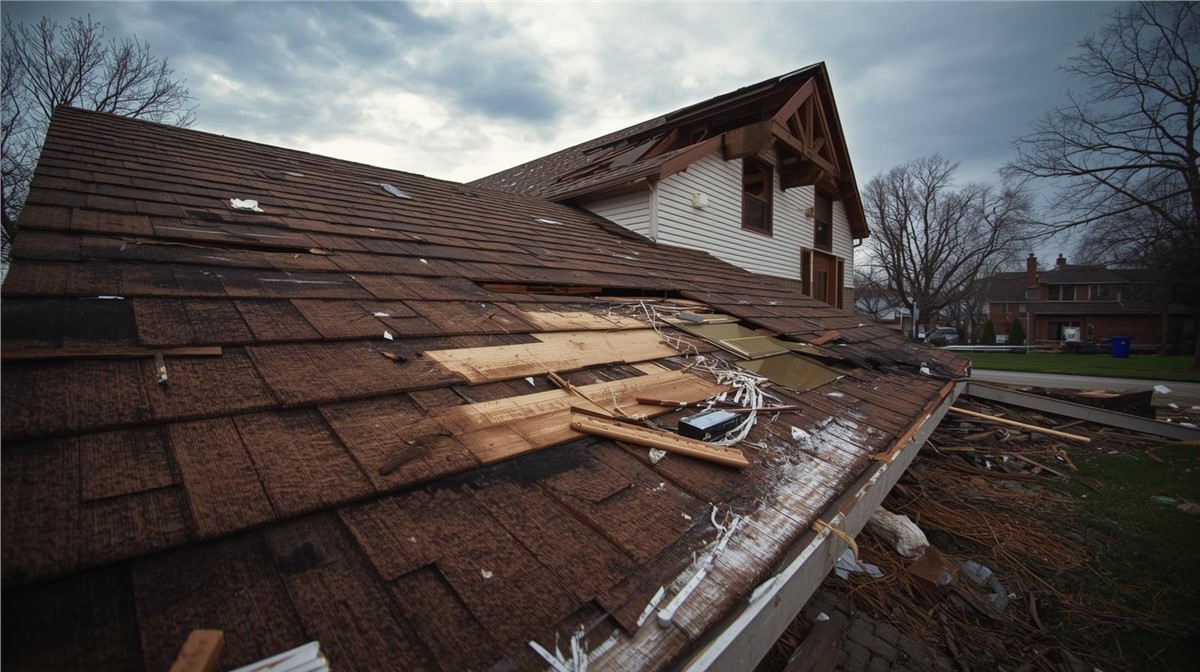
When a storm moves through the Old Orchard area, commercial property owners face a tighter decision window than most realize. Damage to roofing membranes, cladding, windows, and drainage systems on a commercial building can escalate quickly — and the insurance claim clock starts the moment the storm passes. This checklist covers every exterior system worth inspecting after a significant weather event, what to look for on each, and how to move from assessment to action without leaving money or protection on the table.
Why Commercial Storm Damage Is a Different Conversation
A storm that damages a residential roof is a serious problem for one household. A storm that damages a commercial building can affect tenants, customers, employees, inventory, and business continuity simultaneously — while the property owner is also trying to navigate an insurance claim, coordinate contractors, and keep operations running.
The Old Orchard area sits in Cook County, in a part of the Chicago metro that sees meaningful severe weather activity. Spring and summer thunderstorm systems moving across northeastern Illinois regularly produce hail, straight-line winds exceeding 60 mph, and intense rainfall that tests drainage systems across commercial properties of every type. The area's mix of retail, office, medical, and light industrial properties each has its own set of exterior vulnerabilities — and its own set of consequences when storm damage goes unaddressed.
Commercial buildings also have a maintenance and inspection culture that differs from residential. Facility managers are responsible for multiple systems across large surface areas. Roofs may not be walked regularly. Exterior cladding on upper floors may not be visually accessible without equipment. This means storm damage on a commercial building can go undetected longer than it would on a home — with correspondingly more time for water infiltration to compound the original problem.
The Case for Acting Immediately After a Storm
Two things happen simultaneously the moment a storm passes: the damage begins working against your building, and the insurance claim window begins to narrow.
Water infiltration through a compromised roof membrane or damaged wall cladding does not pause while a facility manager gets to it at the end of a busy week. It continues with every subsequent rain event, every temperature swing, and every day that saturated insulation sits against roof decking or wall sheathing. Mold can begin developing in wet building materials within 24 to 48 hours under the right conditions. Structural materials that absorb repeated moisture cycles deteriorate at an accelerating rate.
On the insurance side, most commercial property policies require prompt reporting of damage. Adjusters look at the age of damage, the progression of secondary damage, and the timeline between the storm event and the claim filing. Documentation that was completed within days of a storm is significantly more useful than documentation completed weeks later, when secondary deterioration has muddied the picture of what the storm actually caused.
The practical message: treat post-storm inspection as an immediate priority, not a scheduled item for next week.
The Commercial Storm Damage Checklist
Work through each system below as soon as it is safe to access the property after a storm. For roof-level inspection, use a qualified contractor — commercial roof surfaces require proper equipment and safety protocols that go beyond what most facility managers should attempt independently.
Roofing System
The roof is the first and most consequential system to assess after any significant storm.
Single-ply membrane systems (TPO and EPDM):
- Look for punctures, tears, or splits in the membrane surface — debris impact and hail can breach a membrane in ways that are not visible from building interior until water has already infiltrated
- Inspect all seams for lifting, separation, or bubbling — wind pressure and hail impact stress seam welds and adhesive bonds
- Check membrane at all penetrations — HVAC curbs, pipe boots, exhaust fans, and drains are the highest-risk points for post-storm infiltration
- Assess parapet wall caps and counter-flashing for displacement or damage
- Look for membrane blow-off at edges and corners — wind uplift acts most aggressively at roof perimeter zones
Built-up roofing and modified bitumen:
- Check for gravel displacement that leaves underlying bitumen exposed
- Look for splits, blisters, or ridges that indicate storm stress on an already-aging system
- Inspect base flashing at all walls and curbs for separation or damage
Metal roofing:
- Assess panels for denting, which may compromise protective coatings even when structural integrity appears intact
- Check standing seam joints for stress fractures or displacement
- Inspect fasteners at panel edges for backing out or corrosion acceleration from impact damage
All roof types:
- Document ponding water locations 48 hours after the storm — new ponding that was not present before the event may indicate drainage system damage or membrane deformation
- Inspect all roof drains and scuppers for debris blockage introduced by the storm
- Check interior ceiling directly below the roof surface for new staining, wet spots, or active dripping
- Inspect rooftop HVAC equipment for impact damage, displacement, or compromised base flashing
Exterior Cladding and Wall Systems
Metal panel and composite cladding:
- Inspect all elevations for denting from hail — use a systematic section-by-section approach rather than a quick visual scan, since denting on upper floors is easy to miss from ground level
- Check panel fasteners and clips at the building perimeter, where wind forces are highest
- Look for panels that have shifted, buckled, or separated at joints
EIFS (Exterior Insulation and Finish Systems):
- Hail impact on EIFS creates impact craters that may not be immediately obvious without close inspection — these breach the weather barrier and require prompt repair to prevent water infiltration into the insulation layer beneath
- Check all joints, reveals, and termination points for cracking or separation
- Inspect the base of EIFS walls where they terminate at grade or at flashing transitions — these are points where storm-driven water collects and enters if the system has been compromised
Masonry and brick veneer:
- Look for cracked or displaced mortar joints, particularly at parapet walls and above lintels
- Check brick tie areas and expansion joints for displacement after wind events
- Assess sills and lintels for cracking that could have been worsened by storm impact or wind loading
Glass curtainwall and storefront systems:
- Inspect all glazing for cracks, chips, or shattered units — even minor glass damage compromises the building envelope and is a security concern
- Check frame seals and gaskets for displacement or damage
- Assess door hardware, closers, and threshold seals for storm-related damage
Windows and Glazing
Commercial windows take significant abuse in hail events. Unlike residential windows where individual units are relatively small, commercial storefront and curtainwall glazing can involve large glass areas that are highly vulnerable to impact.
- Walk every elevation and inspect each glazing unit for cracks, chips at edges, or shattered panels
- Check window frames for denting or distortion that prevents proper sash closure or seal contact
- Inspect caulk and glazing compound at frame perimeters — impact and wind pressure can dislodge sealant that was already marginal
- Look for water infiltration staining at window sill areas on interior — a post-storm indicator that frame seals have been compromised
- Assess any operable windows for hardware damage that prevents secure closure
Gutters, Downspouts, and Drainage
Commercial drainage systems handle dramatically more water volume than residential gutters. A compromised drainage system on a large commercial roof can direct significant water volume against the building foundation or into parking and entry areas.
- Inspect all gutters for hail denting — the same circular dent pattern that appears on residential gutters is present on commercial aluminum gutters after hail events and is valuable documentation for insurance purposes
- Check gutter hangers and support brackets for displacement — the weight of debris-loaded gutters after a storm can dislodge hangers that were already marginal
- Assess downspout connections and extensions — storm debris frequently blocks downspout outlets and connections, causing overflow that can saturate foundation areas
- Inspect roof drains and overflow scuppers on flat-roof buildings — debris accumulation at these points after a storm is one of the most common causes of post-storm ponding
- Check interior floor drains in any areas that experienced unexpected water intrusion — these may indicate the drainage system has been overwhelmed or compromised at grade
Signage, Lighting, and Rooftop Equipment
These are frequently overlooked in a post-storm assessment but represent both property damage and liability concerns.
- Inspect all exterior signage for structural damage, displaced panels, or compromised mounting hardware — damaged signage is a public safety concern and a liability issue
- Check exterior lighting fixtures for damage, displacement, or wiring exposure
- Assess rooftop mechanical equipment — HVAC units, condensers, exhaust fans — for impact damage, displacement from bases, or debris that has entered intake areas
- Look for any tree damage, fallen branches, or debris that has contacted the building envelope or is resting against the structure
Documenting Damage for Insurance Purposes
Commercial property insurance claims require more documentation than most facility managers initially anticipate. The following practices protect your claim:
Photograph everything before any cleanup or temporary repair. Wide-angle shots establish context. Close-up shots document specific damage. Date and time stamps matter — photograph with a device that embeds metadata, or note the date and time manually in a log alongside each image.
Record the storm event details. Note the date, approximate time, and any weather service data available for the specific storm — hail size reports, wind speed measurements, and storm track information can be retrieved from the National Weather Service for documented severe weather events and support your claim.
Get a professional written inspection report. An insurance adjuster's assessment and a contractor's independent assessment are not the same document. A detailed written inspection report from an experienced commercial roofing and exterior contractor — prepared promptly after the storm — provides a comprehensive damage inventory that you control and can submit to your insurer.
Do not begin permanent repairs before the adjuster has assessed the damage. Temporary protective measures — tarps, board-ups, emergency drainage — are appropriate and expected. Permanent repairs that remove or cover evidence of damage before the adjuster's visit can complicate your claim.
Track all expenses from the moment of the storm. Emergency protective measures, temporary repairs, business interruption costs, and any damage to business personal property should be documented and submitted as part of the overall claim.
Temporary Protective Measures While Awaiting Repairs
In the period between the storm and the start of permanent repairs, temporary measures can prevent secondary damage from compounding the original problem.
- Roof membrane breaches should be covered with commercial-grade temporary membrane or tarp systems — not standard polyethylene tarps, which are inadequate for commercial roof applications
- Broken glazing should be boarded or temporarily glazed to maintain weather and security protection
- Blocked roof drains should be cleared immediately to prevent ponding that adds structural load and accelerates membrane deterioration
- Any interior areas where water has infiltrated should have standing water extracted promptly and drying equipment deployed — 24 to 48 hours is the critical window for preventing mold development in wet building materials
Why a Local Commercial Exterior Contractor Matters After a Storm
The Old Orchard area attracts storm-chasing contractors after significant weather events — operations that arrive quickly, offer fast timelines, and may not have the experience, equipment, or local accountability that commercial property work requires.
Commercial roof and exterior restoration is not a residential trade with larger numbers. It requires familiarity with commercial membrane systems, proper safety equipment for large flat-roof access, experience with commercial insurance claim documentation, and the project management capability to coordinate multi-system repairs on occupied buildings.
A contractor with an established presence in the Cook County and northeastern Illinois market brings accountability that out-of-area operations do not. They understand local permitting requirements, have relationships with commercial material suppliers, and are present for follow-up if questions arise after the project is complete.
Huskie Exteriors serves commercial and residential property owners across Illinois and Wisconsin, handling roofing, siding, windows, gutters, and storm damage restoration. For commercial clients in the Old Orchard area and throughout northeastern Illinois, the team brings experience with the full scope of commercial exterior systems and the documentation and project management requirements that commercial storm restoration demands.
After the Storm, Before the Next One
Commercial properties in the Old Orchard area that come through severe weather events with the least damage and the smoothest recovery tend to share a few common characteristics: current inspection records, a relationship with a contractor who knows the building, and a facility management team that treats post-storm inspection as a same-week priority rather than a deferred task.
The checklist above is a starting point. A professional exterior inspection fills in the gaps that a facility walk-around cannot — the seam conditions on a flat roof, the EIFS impact damage on an upper floor, the drainage obstruction that will not reveal itself until the next significant rain. Getting that inspection done promptly, with documentation in hand, is the most valuable thing a commercial property owner can do in the days following a storm.
Contact Huskie Exteriors for professional roofing, siding, window, gutter, and storm damage services in Illinois and Wisconsin. If your Old Orchard commercial property was in the path of a recent storm, our team is ready to inspect, document, and walk you through a clear path to restoration.
Subscribe to Huskie Exteriors's Blog





Comments