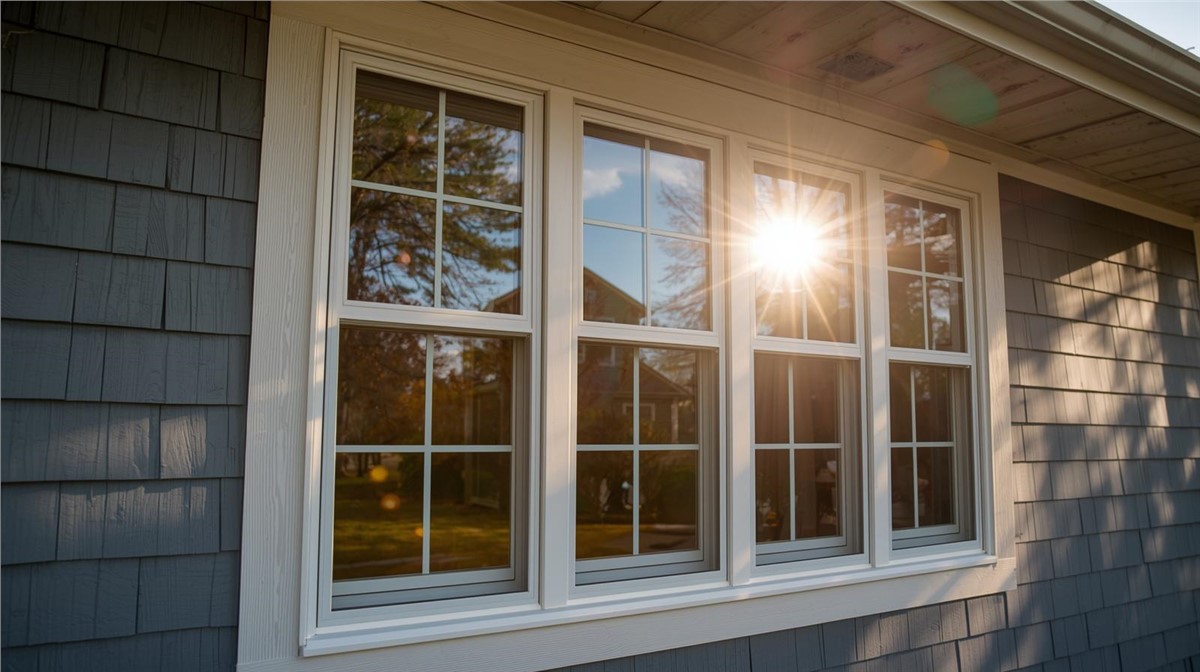
Energy-efficient windows are one of the more impactful exterior upgrades available to homeowners in Oregon, IL — but the market is full of specifications, ratings, and product claims that are easy to misread. This guide cuts through the terminology, explains what actually makes a window perform well in a northern Illinois climate, and helps homeowners evaluate products and contractors with enough knowledge to make a sound decision.
Why Windows Matter More Than Most Homeowners Realize
Windows are the weakest thermal link in any home's building envelope. An insulated wall in a northern Illinois home typically performs at R-13 to R-20 or better. A standard double-pane window performs at roughly R-2 to R-3. Even a high-performance triple-pane window reaches only R-5 to R-8. The gap between wall and window thermal performance is significant — and in a climate like Oregon, IL's, where winters push well below zero and summers bring sustained heat and humidity, that gap translates directly into energy costs and interior comfort.
The windows in most homes in the Oregon area were installed decades ago. Many are original to construction from the 1980s, 1990s, or earlier. Those windows were built to different standards than what is available today — lower-performing glass packages, less thermally efficient frame materials, and none of the low-emissivity coatings that modern windows use to manage radiant heat transfer. Replacing them with properly specified modern units addresses not just energy performance but comfort, condensation control, noise reduction, and the kind of drafts that make certain rooms unusable in January.
Oregon is the county seat of Ogle County, situated along the Rock River in a part of northern Illinois that sees genuine four-season weather stress. The energy performance case for quality replacement windows is strong here. The question is how to evaluate the options available and make a decision that delivers the performance improvement the investment is meant to produce.
The Terminology That Actually Matters
Window shopping — in the literal sense — involves a set of performance ratings and specifications that are easy to confuse or misinterpret. Understanding the ones that matter in a northern Illinois climate makes it possible to evaluate products honestly rather than being guided entirely by marketing language.
U-Factor
U-factor measures how readily a window conducts heat — specifically, how much heat passes through the entire window assembly (glass, frame, and spacer) per hour per square foot per degree of temperature difference between inside and outside.
Lower U-factor means better insulating performance. A single-pane window has a U-factor around 1.0. A standard double-pane window is roughly 0.30 to 0.50. A quality double-pane window with low-e coating and argon fill reaches 0.25 to 0.30. A triple-pane window can reach 0.15 to 0.20.
For a home in Oregon, IL, U-factor is the primary performance metric to focus on. Northern Illinois is a heating-dominated climate — the energy performance of windows matters most in winter, and U-factor directly measures winter heat loss. The lower the U-factor, the less heat your home loses through its windows on a cold night.
Practical guidance: For a northern Illinois home, look for windows with a U-factor of 0.30 or below as a baseline. Triple-pane windows reaching 0.20 or below offer meaningful additional performance, particularly on north-facing windows and in rooms where comfort is a priority.
Solar Heat Gain Coefficient (SHGC)
SHGC measures how much solar radiation — heat from sunlight — passes through a window. It is expressed as a number between 0 and 1. A lower SHGC means less solar heat admitted. A higher SHGC means more.
In a heating-dominated climate like northern Illinois, SHGC is a more nuanced decision than U-factor. South-facing windows with a moderate to higher SHGC can be a net energy benefit in winter — admitting solar heat that reduces heating load during daylight hours. West-facing windows with a high SHGC are a liability in summer, admitting afternoon solar heat that drives up cooling loads significantly.
Practical guidance: For Oregon, IL homes, a moderate SHGC — roughly 0.25 to 0.40 — is appropriate for most orientations. South-facing windows can reasonably use the higher end of that range to capture passive solar gain in winter. West-facing windows benefit from the lower end to limit summer afternoon heat gain. A contractor who recommends a single SHGC specification for the entire house without considering orientation is oversimplifying.
Low-E Coating
Low-emissivity coatings are microscopically thin metallic layers applied to glass surfaces that reduce radiant heat transfer without significantly affecting visible light transmission. They are the technology that makes modern double and triple-pane windows perform so much better than older equivalents at the same glass thickness.
Low-e coatings come in different formulations for different climate priorities. Hard-coat low-e is more durable but less thermally effective. Soft-coat low-e — applied through a vacuum deposition process — provides superior thermal performance and is the standard on quality modern windows. The specific coating position within a multi-pane unit affects whether it is optimized primarily for heating climate performance, cooling climate performance, or a balance of both.
For a northern Illinois home, a low-e coating optimized for heating climate performance — reducing heat loss outward in winter — is the appropriate specification. Most quality window manufacturers offer climate-optimized coating options, and a contractor familiar with the northern Illinois market should be specifying accordingly.
Gas Fill
The space between panes in a double or triple-pane window is filled with an inert gas — typically argon, sometimes krypton — that conducts heat less readily than air. Argon is the standard specification on quality residential windows and provides meaningful performance improvement over air-filled units at a modest cost premium. Krypton conducts heat even less than argon and is used in narrower spaces where argon's performance advantage is limited by the gap width — it is more common in triple-pane units.
The gas fill is only as good as the seal that contains it. A failed insulating seal — the source of the fogging that appears between panes on older double-pane windows — allows gas to escape and ambient air to enter, eliminating the performance advantage entirely. This is why seal quality matters as much as the gas specification in evaluating a window's long-term performance.
Frame Material
The frame conducts heat independently of the glass unit — a window's overall thermal performance includes the frame's contribution to heat loss around the perimeter of the glass.
Vinyl frames are the most common residential window frame material in northern Illinois. They are good thermal insulators, do not conduct heat readily, require no painting, and hold up well through freeze-thaw cycling when quality product is specified. Multi-chamber vinyl frames — with internal air chambers that add insulating value — perform better than single-chamber designs.
Fiberglass frames are dimensionally more stable than vinyl across temperature extremes — they expand and contract at a rate closer to glass itself, which reduces seal stress over decades of thermal cycling. In a climate with Oregon, IL's temperature range, this dimensional stability advantage is meaningful. Fiberglass frames are more expensive than vinyl but are worth considering for homeowners prioritizing long-term performance.
Wood-clad frames offer the thermal performance and dimensional stability of wood on the interior with a low-maintenance exterior cladding — typically aluminum or fiberglass — that protects against weather exposure. They provide excellent thermal performance and a traditional interior aesthetic. Higher cost and more maintenance attention than vinyl or fiberglass.
Aluminum frames conduct heat readily and perform poorly as insulators without a thermal break — a non-conductive separator between inner and outer frame components. Thermally broken aluminum frames are used in commercial applications but are less common in residential windows for energy efficiency reasons. Standard aluminum frames without a thermal break are not appropriate for a northern Illinois home prioritizing energy performance.
Double-Pane vs. Triple-Pane: Is the Upgrade Worth It?
For most homes in Oregon, IL, quality double-pane windows with low-e coating, argon fill, and a thermally efficient frame represent the appropriate baseline specification — and the step change in performance from older single-pane or failed double-pane windows is already substantial.
Triple-pane windows offer genuine additional performance — lower U-factors, better sound attenuation, and reduced condensation risk on cold surfaces. They are worth the additional cost in specific situations.
Triple-pane makes the most sense when:
- The home has north-facing windows that face into prevailing winter wind
- Comfort in specific rooms during winter is a persistent problem despite good HVAC performance
- The home is in a location with significant exterior noise that the additional glass layer would attenuate
- The homeowner is pursuing a very high-performance building envelope and the window specification needs to match that standard
- Long-term energy cost savings are a priority and the ownership horizon is long enough to recover the additional upfront cost
Double-pane with quality specifications is appropriate when:
- The primary goal is replacing failed or single-pane windows with a meaningful, cost-effective performance upgrade
- Budget considerations make the triple-pane premium difficult to justify across all windows
- The home has mixed orientations where the incremental benefit of triple-pane varies significantly by window location
A practical approach for some Oregon homeowners is a mixed specification — triple-pane on north and west elevations where heat loss and solar gain are most consequential, quality double-pane elsewhere. A contractor who understands window performance and northern Illinois climate can help model which approach makes sense for a specific home.
What Proper Installation Delivers That the Window Itself Cannot
A well-specified window installed incorrectly will underperform a modest window installed with attention to detail. Installation quality determines whether the energy performance the product is rated for is actually delivered in the home.
The installation details that matter most:
Rough opening preparation. The opening needs to be structurally sound, properly shimmed to square and level, and free of moisture damage before the new window goes in. A window installed in a compromised rough opening will rack over time, compromising seal contact and operability.
Head flashing. Flashing above the window directs water that gets behind the cladding over the top of the window and out, rather than into the rough opening. Skipped or inadequate head flashing is the primary cause of water infiltration at window installations — and it is completely invisible once cladding is in place.
Pan flashing at the sill. A sloped pan flashing at the window sill directs any water that infiltrates at the sill joint outward and away from the rough opening. Without it, water pools at the sill and works into the framing below.
Air sealing at the frame perimeter. The gap between the window frame and the rough opening needs to be insulated and air-sealed — typically with low-expansion spray foam or backer rod and sealant — to eliminate the air infiltration pathway that accounts for a significant share of window-related heat loss.
Exterior caulking. The joint between the window frame and the exterior cladding needs to be caulked with a flexible, paintable sealant compatible with both surfaces. This joint moves with thermal cycling — the sealant needs to accommodate that movement without cracking.
Integration with surrounding cladding. Window replacement done in conjunction with siding work allows all of these details to be executed correctly because the cladding is accessible. Window replacement done in isolation — inserting a new window into an existing opening without disturbing the surrounding cladding — limits what can be done at the flashing and air sealing level. It is a common approach and often practical, but it means some installation details are executed at a lower standard than full-opening replacement allows.
Reading the ENERGY STAR Label
ENERGY STAR certification for windows is based on U-factor and SHGC thresholds that vary by climate zone. Illinois falls in the Northern climate zone under the ENERGY STAR program — the most demanding zone, with the lowest U-factor requirements.
ENERGY STAR certification is a useful baseline indicator — it confirms that a window meets minimum performance thresholds for the climate zone. It is not a guarantee of top-tier performance, since a product can meet ENERGY STAR thresholds at the minimum required level. Think of it as a floor, not a ceiling.
When comparing products, use the actual rated U-factor and SHGC numbers rather than relying solely on the ENERGY STAR label. Two ENERGY STAR-certified windows for the Northern zone can have meaningfully different actual performance levels — and those differences matter over decades of northern Illinois weather.
Tax Credits and Incentives Worth Knowing About
Federal energy efficiency tax credits have been available for qualifying window replacements in recent years under the Inflation Reduction Act provisions. The credit covers a percentage of the cost of qualifying windows meeting specific U-factor and SHGC thresholds, subject to an annual cap.
Tax credit availability and terms change with legislation, so verifying current eligibility with a tax professional or through current IRS guidance before making purchasing decisions based on credit availability is important. A contractor should be able to provide the product specifications — ENERGY STAR certification, U-factor, and SHGC ratings — needed to evaluate whether a specific window qualifies.
Utility rebates for energy-efficient window replacement are also available from some Illinois utilities. These programs change frequently — checking with your utility provider directly for current availability is worth doing before finalizing a purchase decision.
Putting It Together for an Oregon, IL Home
The practical window specification for most homes in Oregon, IL, using the framework above:
- Frame material: Vinyl (multi-chamber) or fiberglass for long-term thermal performance and dimensional stability
- Glass package: Double-pane minimum; triple-pane on north and west elevations or where comfort and performance are priorities
- Low-e coating: Soft-coat, heating climate optimized
- Gas fill: Argon standard; krypton in triple-pane units where gap width justifies it
- U-factor: 0.30 or below for double-pane; 0.20 or below for triple-pane
- SHGC: 0.25 to 0.35 for most orientations; moderate to higher on south-facing windows; lower on west-facing windows
- ENERGY STAR: Northern zone certified as a baseline confirmation
This specification represents a meaningful performance upgrade from windows installed before 2000, and a substantial upgrade from single-pane originals — in heating cost, cooling cost, comfort, and condensation control simultaneously.
Making the Investment Count
Energy-efficient windows are a long-term investment — one that pays in reduced energy costs, improved comfort, reduced condensation and moisture risk, and a home that is simply more livable through an Oregon, IL winter. Getting the specification right and the installation quality right determines whether the investment delivers what it is capable of delivering.
A contractor who understands window performance in a northern Illinois climate — who specifies by U-factor and SHGC rather than by brand name alone, who discusses orientation when making recommendations, and who treats installation details as seriously as product selection — is the partner that makes this investment worthwhile.
Contact Huskie Exteriors for professional roofing, siding, window, gutter, and storm damage services in Illinois and Wisconsin. If your Oregon, IL home has windows that are underperforming — or if you are ready to evaluate a replacement project — our team is ready to walk you through what makes sense for your home, your climate exposure, and your budget.
Subscribe to Huskie Exteriors's Blog





Comments