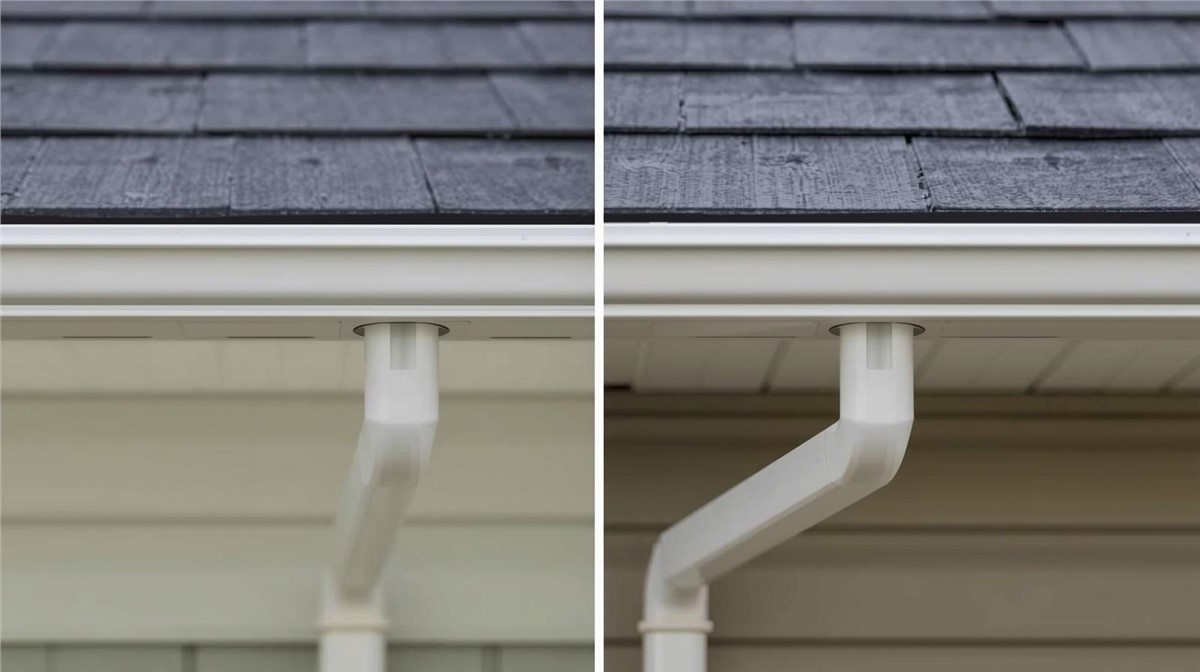
In Elgin, IL, 5-inch gutters are usually enough for many standard homes with simpler rooflines, while 6-inch gutters are often the better choice for larger roofs, steeper pitches, heavier rain flow, or homes that have struggled with overflow before. In simple terms, 5-inch gutters are often the more budget-friendly default, while 6-inch gutters are the stronger performance option when drainage capacity matters more.
Why This Matters in Elgin, IL
Gutter size matters more than many homeowners think. In Elgin, IL, gutters do more than catch rain coming off the roof. They help protect the fascia, siding, landscaping, walkways, and foundation by moving water away from the house in a controlled way. When the gutter system is too small for the roof area or water volume, even a well-installed system can overflow during stronger rain.
That matters even more in northern Illinois, where homes deal with heavy rain, spring storms, snowmelt, and freeze/thaw cycles. In this kind of climate, a gutter system that is only barely large enough can start showing problems faster than homeowners expect. Overflow may not seem like a big issue at first, but repeated runoff over the gutter edge can stain siding, wear out fascia, erode landscaping, and leave too much water near the foundation.
For homeowners in Elgin, IL, the real question is not whether 6-inch gutters are better in every case. They are not always necessary. The better question is whether your house actually needs the extra capacity. A 5-inch system can still perform very well on the right home. But once roof size, pitch, runoff volume, or overflow history become part of the picture, the larger gutter often makes more long-term sense.
Common Signs Your Home May Need Larger Gutters
- Overflow during heavy rain
If water spills over the front edge even when the gutters are fairly clean, capacity may be part of the problem. - Frequent clogs near downspouts
Smaller gutters can be more prone to backing up when debris and heavy roof runoff combine. - Long roof runs
Longer gutter sections often benefit from more capacity, especially when water has farther to travel before reaching a downspout. - Steep roof sections
Steeper roofs shed water faster, which can overload a smaller gutter more easily. - Metal roofing or fast-shedding roof surfaces
Some roof materials move water off the house more quickly, which increases the demand on the gutter system. - Past water issues near the foundation
If runoff has been spilling too close to the house, better gutter capacity may be part of the solution. - Repeated storm-related overflow
If the same gutter sections struggle every time a strong storm comes through, the size may be worth reevaluating.
When to Choose 5-Inch Gutters
For many homes, 5-inch gutters are still the most common and practical choice. They usually make sense when:
- the home has a standard-sized roof
- the roofline is fairly simple
- the pitch is not especially steep
- overflow has not been a recurring issue
- the home does not have unusually long gutter runs
- the budget is a bigger concern than extra drainage capacity
A lot of homes do just fine with 5-inch gutters, especially when the downspouts are correctly placed and the gutters are kept clean. If the roof is average in size and the system has not shown overflow or drainage problems, there may be no strong reason to go larger.
For homeowners trying to control upfront cost, 5-inch gutters often make sense because they usually cost less in both material and installation. That makes them a reasonable default for many standard residential homes.
When to Choose 6-Inch Gutters
6-inch gutters usually make more sense when the house puts more water into the system than a standard setup can comfortably manage.
They are often the better fit when:
- the roof is larger than average
- the pitch is steeper
- the home has long straight gutter runs
- the house has a history of overflow
- the roof sheds water quickly
- the homeowner wants more storm capacity and less risk of clog-related backup
The biggest reason homeowners choose 6-inch gutters is capacity. They can handle more water, and they also usually pair with larger downspouts. That combination often helps more during strong rain than homeowners realize. The larger system is not just about holding more water in the gutter itself. It is also about moving that water out of the system faster.
In Elgin, where strong spring and summer weather is a realistic concern, the added capacity can be worth it for homeowners who want a little more performance margin during heavier storms.
What a Professional Gutter Sizing Evaluation Includes
A professional gutter sizing review should focus on runoff volume, not just on what size is most common.
Typical checklist:
- Roof area measurement
Roof size is one of the main factors in gutter sizing. - Roof pitch review
Steeper roofs increase runoff speed and volume. - Run length assessment
Longer gutter runs often need more capacity or better downspout placement. - Downspout sizing review
Bigger gutters often need bigger downspouts to deliver the full benefit. - Overflow history
If the home already has a known overflow problem, that should weigh heavily in the recommendation. - Drainage discharge review
Water still has to be carried away from the foundation after it leaves the gutter.
At Huskie Exteriors, the goal is to help homeowners understand whether the current size is adequate or whether upsizing would solve a real drainage issue instead of just repeating the same setup.
What This Typically Costs in Elgin, IL (2026 Pricing)
For homeowners in Elgin, IL, 6-inch gutters usually cost more than 5-inch gutters because they use more material, often require larger downspouts, and may involve a slightly more robust installation setup.
Realistic 2026 cost patterns usually look like this:
- 5-inch gutters: usually the lower-cost option
- 6-inch gutters: typically cost more upfront
- larger downspouts: may add to total cost but improve performance
- full project pricing: depends on linear footage, material, home height, and fascia condition
Top five cost factors:
Gutter Size
This is the core comparison. A 6-inch system costs more because it provides more capacity and usually works with larger outlets.
Downspout Size
A bigger gutter without properly sized downspouts does not solve as much as homeowners expect. Downspout sizing plays a major role in real drainage performance.
Roof Complexity
Dormers, valleys, steep sections, and long runs all affect labor and sizing choices.
Home Height and Access
Two-story homes and hard-to-reach rooflines increase installation cost regardless of gutter size.
Fascia and Drainage Condition
If the fascia needs repair or the discharge path also needs improvement, the total cost rises beyond the gutter swap itself.
In simple terms, 5-inch gutters usually save money up front. 6-inch gutters often make more sense when you are trying to avoid overflow, reduce clogging risk, or give the system more storm capacity.
Insurance / Permits / Local Notes in Elgin, IL
For most homeowners, choosing 5-inch vs 6-inch gutters is a home-improvement and drainage decision rather than an insurance issue. Insurance may matter only if gutter work is tied to covered storm damage.
A few local notes matter here:
- Elgin homeowners should verify whether permit coordination is needed before starting gutter replacement work.
- Northern Illinois weather includes heavy rain, snowmelt, and storm-driven runoff, which makes gutter performance more important than it would be in a calmer climate.
- Roof area, pitch, and runoff volume should drive the sizing decision more than appearance alone.
How to Choose the Right Contractor in Elgin, IL
The right contractor should explain why a certain size fits your home instead of simply quoting the size they install most often.
Questions to ask:
- Is 5-inch enough for this roof, or do you recommend 6-inch?
- How much roof area drains into each gutter run?
- Are the downspouts sized correctly for the gutter system?
- Has this house shown any signs of overflow before?
- Are you measuring pitch and run length, or just replacing what is there now?
- Are you insured for exterior work in Illinois?
- Will you verify whether Elgin permit coordination is needed?
Red flags:
- recommending a size without measuring the roof
- no discussion of downspouts
- no review of overflow history
- assuming all homes only need 5-inch gutters
- pushing 6-inch gutters with no explanation of the actual benefit
Mistakes Homeowners Make (And How to Avoid Them)
- replacing gutters with the same size without asking whether that size was ever correct
- focusing only on price instead of water capacity
- overlooking downspout sizing
- ignoring overflow during heavy rain
- assuming bigger is always necessary
- choosing based only on appearance
- not considering roof pitch and runoff speed
FAQs
Are 6-inch gutters better than 5-inch gutters?
Not always for every house. They are better when the home needs more water capacity, longer runs, or bigger downspouts. On a simpler roof, 5-inch gutters may still be enough.
How much more water do 6-inch gutters hold?
A 6-inch gutter system is commonly treated as providing significantly more capacity than a 5-inch system, which is one reason it is recommended for larger or steeper roofs.
When should I upgrade to 6-inch gutters?
Usually when you have a larger or steeper roof, long gutter runs, fast-shedding roofing, or a history of overflow during strong rain.
Do bigger gutters need bigger downspouts?
Usually yes. Larger gutters often perform best when paired with larger downspouts so the system can move water out quickly.
Do I need a permit for gutter replacement in Elgin, IL?
Possibly, depending on scope. Homeowners should confirm permit requirements with the city or have the contractor verify them before work begins.
Get a Free Estimate in Elgin, IL
If you are comparing 5-inch vs 6-inch gutters in Elgin, IL, Huskie Exteriors is here to help with honest sizing guidance and practical drainage recommendations built for Midwest weather. We serve homeowners across Northern Illinois and Southern Wisconsin with gutters, roofing, siding, and windows designed for long-term performance.
Schedule your free estimate with Huskie Exteriors today. We will inspect your roofline, explain which gutter size makes more sense for your home, and help you choose the right system with confidence.
Subscribe to Huskie Exteriors's Blog







Comments